JX-WT60 Dedicated Test Solution — Experimental Report
Test Scenario · Conditions · Procedure · Raw Data · PQ Curve Results
Guangzhou Jingxiu Thermal Equipment Co., Ltd (GZ-THERMOTEX) | October 2026
The challenge in testing scroll-free centrifugal fans is not whether the equipment can produce data, but whether the data represents the fan’s real performance inside the final product.
Guangzhou Jingxiu Thermal Equipment Co., Ltd (GZ-THERMOTEX) provides a complete PQ performance testing solution for these dual-inlet fans, pairing the JX-WT60 airflow and pressure measurement station with custom mounting tooling. This article documents a full, typical test to show how the solution performs in a real laboratory scenario.
Executive Summary
Scenario: A miniature scroll-free centrifugal fan for handheld vacuums, PQ performance tested on the JX-WT60 per AMCA 210-07, with a control experiment comparing “both inlets open” vs. “rear inlet blocked.”
Process: Custom fixture mounting and sealing → airtightness check → pre-run → automatic acquisition at 7 operating points → control experiment → software-generated PQ curve and report.
Result: At the same operating point, measured airflow was 31.0 CFM with both inlets open versus 19.0 CFM with the rear inlet blocked — about 39% lower — while speed and power readings stayed close. The difference came from the mounting state, not the fan itself.
1. Test Background and Sample
The sample was a miniature scroll-free brushless centrifugal fan of the type commonly used in handheld vacuum cleaners. Without a volute housing, these fans rely on the end-product enclosure to collect airflow. A key structural feature is the dual-inlet design: air enters through both the rear face and the gap between the impeller and its bracket, with both streams entering simultaneously.
Test objective: obtain the fan’s PQ (flow rate–static pressure) performance curve in accordance with AMCA 210-07, and quantify the measured difference between two mounting states — “both inlets open” versus “rear inlet blocked.”
2. The Solution: A Complete Test Record
Taking a typical test of a handheld-vacuum scroll-free centrifugal fan as an example, this chapter presents the full experimental record in the order it was performed: scenario and setup, test conditions, procedure, raw data, and results. All data shown are illustrative, used to demonstrate how the solution is executed and how the report is formatted; actual test values are subject to the official test report.
2.1 Test Scenario and Sample Preparation
Testing was carried out on the JX-WT60 airflow and pressure measurement station in the GZ-THERMOTEX laboratory. A custom mounting fixture was built to match the sample’s structure: the fan’s outlet side was coupled and sealed to the fixture’s outlet port; a complete inlet plenum was reserved between the fan’s rear face and the chamber wall; the impeller-to-bracket gap side was left unobstructed, so both inlet paths could draw air freely.
Before testing, the sample was inspected for cosmetic integrity and abnormal noise, and connected to an adjustable DC power supply at its rated parameters.
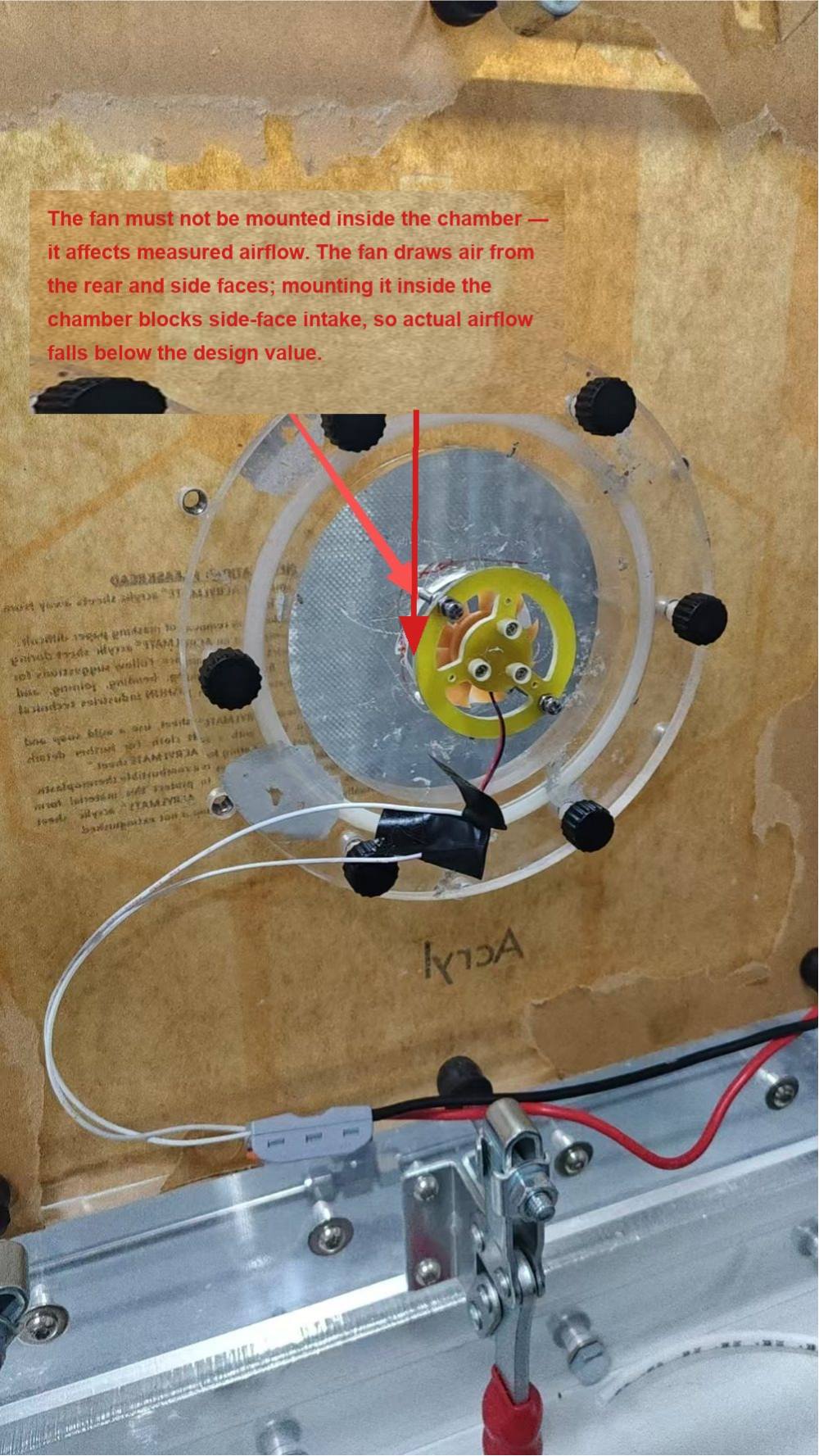
Fig. 1 Custom mounting fixture built to the sample’s structure: outlet side sealed; rear and gap inlet paths kept clear
2.2 Test Conditions
| Condition |
Setting |
| Standard |
AMCA 210-07 |
| Ambient temperature |
23±2 °C |
| Atmospheric pressure |
101.3 kPa |
| Power supply |
Rated DC voltage, held constant throughout |
| Rotational speed |
Captured automatically by the test station and logged throughout |
| Operating points |
7 (damper adjusted from fully open to fully closed) |
| Stabilization per point |
Recorded after readings stabilized; 3 consecutive acquisitions averaged |
2.3 Procedure
- Mounting and sealing: Install the fan into the custom fixture; check the outlet-port seal; confirm both inlet paths (rear face and gap) are unobstructed and free of foreign objects.
- Airtightness check: Close the damper and perform a background leakage check to confirm the test chamber meets the standard’s sealing requirements.
- Pre-run: Pre-run for 10 minutes at rated conditions; begin data acquisition after speed and power stabilize.
- Point-by-point acquisition: Adjust the damper opening to set each operating point; the cylinder automatically switches nozzle combinations, and the system automatically acquires flow rate, static pressure, speed, and power at each point.
- Control experiment: With all conditions unchanged, block only the fan’s rear inlet passage and repeat the acquisition, to compare the effect of mounting state on results.
- Data export: The test software automatically generates the PQ curve and exports the test report and raw data log.
2.4 Raw Data Record
Acquisition results with both inlets open (rear face and gap paths unobstructed):
| Point |
Flow Q (CFM) |
Static pressure Ps (mmAq) |
Speed (rpm) |
Power (W) |
| 1 |
0.0 |
196 |
27950 |
26 |
| 2 |
8.0 |
188 |
28000 |
28 |
| 3 |
16.0 |
172 |
28100 |
30 |
| 4 |
24.0 |
148 |
28200 |
32 |
| 5 |
31.0 |
112 |
28300 |
34 |
| 6 |
37.0 |
68 |
28400 |
36 |
| 7 |
42.0 |
26 |
28500 |
38 |
Under identical test conditions, with only the rear inlet passage blocked, the same operating point gave:
| Mounting state |
Flow Q (CFM) |
Static pressure Ps (mmAq) |
Speed (rpm) |
Power (W) |
| Both inlets open |
31.0 |
112 |
28300 |
34 |
| Rear inlet blocked |
19.0 |
128 |
28300 |
33 |
Note: The data above are illustrative for this type of sample, shown to demonstrate the record format and order of magnitude; actual values for different samples are subject to their test reports.
2.5 Results and Analysis
The test software automatically generated PQ curves for both mounting states, compared below:
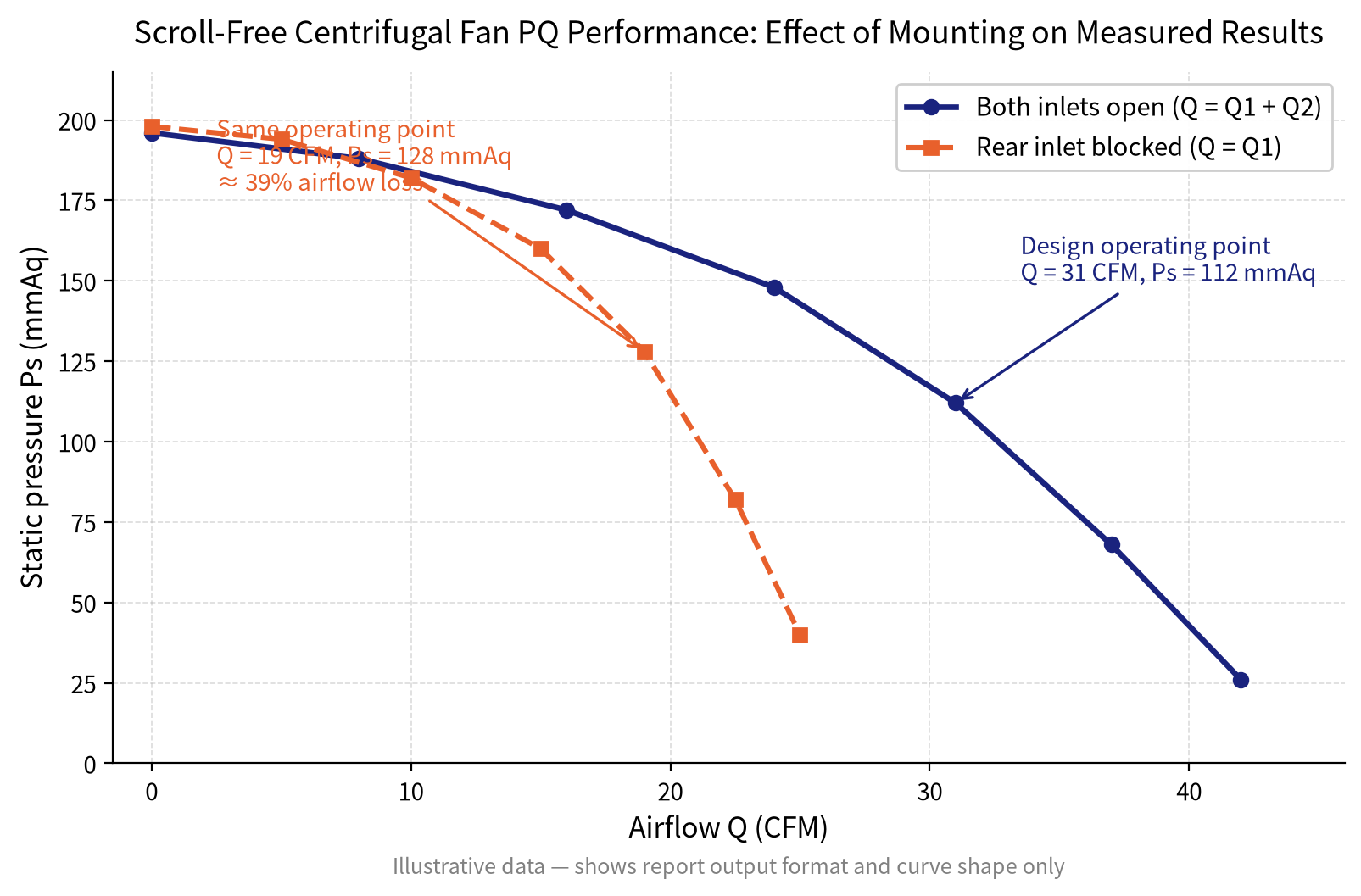
Fig. 2 PQ curve comparison under both mounting states (illustrative data; shows report output format and curve shape)
At the same operating point (Point 5), measured airflow was 31.0 CFM with both inlets open, dropping to 19.0 CFM with the rear inlet blocked — a loss of about 39% — while the static pressure reading actually rose, the classic signature of restricted airflow. If the blocked-state curve were used for R&D selection or as a factory acceptance criterion, the fan’s airflow capability would be underestimated by roughly two-fifths.
The experiment also showed that speed and power readings were close in both states, indicating the difference did not come from supply or load fluctuations but from the mounting state itself. This explains why a fan can look excellent on the lab bench yet underperform in the final product: the root cause is usually the test mounting, not the fan.
3. Reproducibility of the Solution
For miniature fan manufacturers, this process transfers directly to daily R&D and quality inspection:
- Sample changeover: Different scroll-free fan structures only require swapping the matching custom fixture; the test station and procedure stay the same.
- Consistent standard: The entire process follows AMCA 210-07, so data are traceable and suitable for R&D validation, incoming inspection, and third-party comparison.
- Data retention: Test records, PQ curves, and reports are archived automatically by the software for traceability and cross-comparison.
- Capability extension: The same station, with different fixtures and configurations, also covers conventional axial fans and voluted blowers.
4. About GZ-THERMOTEX
Guangzhou Jingxiu Thermal Equipment Co., Ltd (GZ-THERMOTEX) specializes in the R&D and manufacture of fan airflow and pressure testing equipment, providing complete performance testing solutions for miniature fan manufacturers in handheld vacuums, beauty devices, portable sampling equipment, and small blowing tools, with support for custom fixtures, equipment commissioning, and technical solution integration.
WhatsApp: +86 19128688310
Website: https://www.fluiomet.com/
Guangzhou Jingxiu Thermal Equipment Co., Ltd | October 2026






 IPv6 network supported